
Sponsored by:.jpg)
Since 2019, when Air Force, Army, and Navy leadership issued a joint memo mandating that the U.S. military use a modular open systems approach (MOSA) for new program designs and refreshes, MOSA has gone from concept to buzzword to a common part of program requirements across multiple domains – air, land, sea, space, and spectrum. MOSA is changing the way companies do business with the U.S. Department of Defense (DoD) through MOSA initiatives like FACE, SOSA, CMOSS, and others.
Powered by Military Embedded Systems, the 2025 MOSA Virtual Summit is designed to drive awareness and thought leadership around MOSA as what the DoD memo termed a “warfighting imperative,” and explores MOSA examples like the Sensor Open Systems Architecture, or SOSA, approach; the C5ISR/EW Modular Open Suite of Standards (CMOSS); and the Future Airborne Capability Environment, or FACE, approach with the aim of studying how they impact signal-processing, software, hardware, AI, and RF designs.
Since 2019, when Air Force, Army, and Navy leadership issued a joint memo mandating that the U.S. military use a modular open systems approach (MOSA) for new program designs and refreshes, MOSA has gone from concept to buzzword to a common part of program requirements across multiple domains – air, land, sea, space, and spectrum. MOSA is changing the way companies do business with the U.S. Department of Defense (DoD) through MOSA initiatives like FACE, SOSA, CMOSS, and others.
Powered by Military Embedded Systems, the 2025 MOSA Virtual Summit is designed to drive awareness and thought leadership around MOSA as what the DoD memo termed a “warfighting imperative,” and explores MOSA examples like the Sensor Open Systems Architecture, or SOSA, approach; the C5ISR/EW Modular Open Suite of Standards (CMOSS); and the Future Airborne Capability Environment, or FACE, approach with the aim of studying how they impact signal-processing, software, hardware, AI, and RF designs.
Thu, Feb. 26, 2026 · 8:00 am (PST)
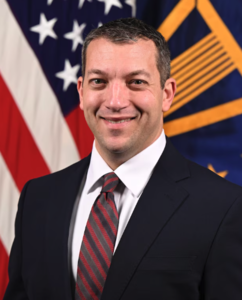
Deputy Assistant Secretary of War for Science and Technology (DASW S&T)
Jake currently is Performing The Duties of (PTDO) the Assistant Secretary of War for Science and Technology (ASW S&T). In this role Jake serves as the principal advisor to the Under Secretary of War for Research and Engineering (USW(R&E)) on matters related to S&T, developmental prototyping, and experimentation, acting as a crucial link between fundamental scientific discovery and its strategic application in defense. Jake served as the Senior Technical Advisor to the Assistant Secretary of Defense for Research, Development and Acquisition (ASN RD&A). In this role Jake was responsible for implementation of Modular Open System Architecture (MOSA) and Artificial Intelligence (AI) as well as rapid acquisition in the Department of Navy and the Marine Corps. Jake previously served as Director of Advanced Capabilities for the Conventional Prompt Strike (CPS) Program. He was responsible for developing and integrating critical new technologies in conjunction with the US Army and DARPA into the CPS platform with an annual budget of over $60M. Jake served as a Program Manager at the Strategic Capabilities Office (SCO) in Artificial Intelligence (AI) and Unmanned Systems transitioning critical technology to the warfighter and Program Lead for Team Submarine Project Turing rapidly introducing AI into the undersea domain with a total budget of $140M. Jake served as the Assistant Program Manager (APM) for Submarine Combat Future Development and the Payload Control System (PCS) in NAVSEA PEO Submarine with an annual budget of over $30M. His portfolio as APM included all Payload control and integration including unmanned vehicles, missiles and torpedoes for the BYG-1 Combat Control System and the Common Weapon Launchers (CWL). In his future development portfolio Jake was the Program Manager for the Submarine Launched Unmanned Aerial System (SLUAS) providing command and control as well as a Virtual Twin Combat System for the US and Australian Submarine Force.
Jake served as the SEA05 System Design Manager (SDM), Technical Warrant Holder and Chief Engineer for a SCO program in the Unmanned Maritime Systems Program, PMS 406 Program Office. Jake has extensive Naval Engineering experience from with the Remote Minehunting System (RMS) as the lead software engineer and extensive submarine development and engineering experience with the BYG-1 Submarine Combat Control System.
Jake’s first job with the Department of the Navy was a CO-OP at Lockheed Martin Moorestown during his undergraduate study at Drexel University in Philadelphia spending three years working Aegis Ballistic Missile Defense in charge of test development and simulations of the combat system capability. Upon graduating Jake joined the Federal Service at the Naval Surface Warfare Center Carderock Division Hydrodynamics group spending 4 years as the In Service Engineering Agent (ISEA) for the Seawolf Class Submarine Ship Control System and Data Distribution System.
Jake first came to the Naval Sea Systems Command (NAVSEA) in 2011 serving as the lead software engineer for the RMS and AN/AQS-20A sonar system. From 2012 to 2014 he served as lead engineer of the Submarine Weapon Control System and head of the Open Architecture initiative for the BYG-1 Submarine Combat Control System.
Jake has received several NAVSEA awards including a NAVSEA Innovation Award over his career for innovation and excellence in engineering. Jake was recognized as Engineer of the Year (2020) by ASNE and has been published by the Naval Submarine League on Combat Systems of the Future. He has a Bachelor’s of Science (BS) in Computer Engineering from Drexel University, a Master’s of Science (MS) in Systems Engineering from The George Washington University, a Master’s in Business Administration (MBA) from the University of Maryland and is completing a Masters of Arts (MA) in Strategic Studies at the Naval War College.
Jake served as the SEA05 System Design Manager (SDM), Technical Warrant Holder and Chief Engineer for a SCO program in the Unmanned Maritime Systems Program, PMS 406 Program Office. Jake has extensive Naval Engineering experience from with the Remote Minehunting System (RMS) as the lead software engineer and extensive submarine development and engineering experience with the BYG-1 Submarine Combat Control System.
Jake’s first job with the Department of the Navy was a CO-OP at Lockheed Martin Moorestown during his undergraduate study at Drexel University in Philadelphia spending three years working Aegis Ballistic Missile Defense in charge of test development and simulations of the combat system capability. Upon graduating Jake joined the Federal Service at the Naval Surface Warfare Center Carderock Division Hydrodynamics group spending 4 years as the In Service Engineering Agent (ISEA) for the Seawolf Class Submarine Ship Control System and Data Distribution System.
Jake first came to the Naval Sea Systems Command (NAVSEA) in 2011 serving as the lead software engineer for the RMS and AN/AQS-20A sonar system. From 2012 to 2014 he served as lead engineer of the Submarine Weapon Control System and head of the Open Architecture initiative for the BYG-1 Submarine Combat Control System.
Jake has received several NAVSEA awards including a NAVSEA Innovation Award over his career for innovation and excellence in engineering. Jake was recognized as Engineer of the Year (2020) by ASNE and has been published by the Naval Submarine League on Combat Systems of the Future. He has a Bachelor’s of Science (BS) in Computer Engineering from Drexel University, a Master’s of Science (MS) in Systems Engineering from The George Washington University, a Master’s in Business Administration (MBA) from the University of Maryland and is completing a Masters of Arts (MA) in Strategic Studies at the Naval War College.

EVP & Group Editorial Director, Military Embedded Systems
Thu, Feb. 26, 2026 · 8:45 am (PST)
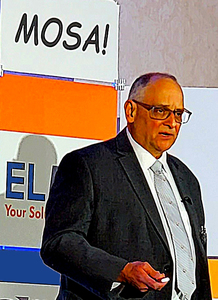
Director, Embedded Technologies, Elma Electronic
Ken Grob is director, embedded technologies for Elma Electronic and is responsible for driving the company’s integrated platform solutions. He holds a BSEE from Drexel University in Philadelphia, landing first at IBM, and later became the co-owner of a well-respected embedded sub-systems integration company. He is a highly respected technical expert in the embedded computing open architectures and an active contributor to VITA standards and the SOSA™ Technical Standard.

EVP & Group Editorial Director, Military Embedded Systems
Thu, Feb. 26, 2026 · 10:00 am (PST)

Principal Application Engineer, RTI
Andre Odermatt is a Principal Application Engineer for Real-Time Innovations (RTI). He received his BS in Electrical Engineering from the Lucerne School of Engineering and Architecture, and Diploma of advanced studies in software engineering from the Bern University of Applied Science. Andre has over 20 years of experience in embedded software development and communication software. Prior to RTI, he worked on Telecom protocols at Alcatel where he developed test systems for Asynchronous Transfer mode systems and Trillium Digital Systems where he was responsible for the SS7 product line. Andre is also involved in the FACE consortium where he participates in the IWS working group and works on multiple integration projects for the TIM and BITS events.

Vice President of Marketing, DDC-I
Gary Gilliland has over 30 years of experience in the development and marketing of hardware and software solutions for embedded systems, with extensive experience in both military and commercial avionics. A graduate of the University of Texas at Arlington, with a degree in electrical engineering, Gary was previously Technical Marketing Manager at DDC-I, where he has been responsible for product development, technical marketing, partner relationships and customer facing technical support with special expertise integrating Deos in avionics systems.
Prior to joining DDC-I, Gary was responsible for business development at LynuxWorks for the DO-178 product, managed Technical Marketing and field sales engineers. Prior to LynuxWorks Gary held engineering management and engineering positions developing commercial and military embedded systems for aerospace and defense applications at Honeywell, Lockheed Missiles and Space and LTV Aerospace and Defense.
Prior to joining DDC-I, Gary was responsible for business development at LynuxWorks for the DO-178 product, managed Technical Marketing and field sales engineers. Prior to LynuxWorks Gary held engineering management and engineering positions developing commercial and military embedded systems for aerospace and defense applications at Honeywell, Lockheed Missiles and Space and LTV Aerospace and Defense.
Thu, Feb. 26, 2026 · 11:15 am (PST)

Vice President of Strategic Planning and a Technical Fellow, Curtiss-Wright
David Jedynak is Vice President of Strategic Planning and a Technical Fellow. Previously, he served as Chief Technology Officer for Curtiss-Wright Defense Solutions for many years and continues to provide technology leadership for the group. David joined Curtiss-Wright in 2008, and has focused his expertise in network-centric systems, COTS solutions and Assured Position, Navigation and Timing. He actively drives and supports the adoption of modular open standard approach (MOSA) architectures for the defense industry to accelerate technology deployment. Prior to joining Curtiss-Wright, David worked in both the automotive electronics and film industries on the forefront of industry-wide migrations to cutting-edge open standard digital architectures. He holds a BS Electrical Engineering from UCLA, as well as a Certificate in Astronautical Engineering and a Certificate in Project Management, both also from UCLA.

FACE Consortium Program Director, The Open Group
Alicia Taylor serves as the Program Director for The Open Group FACE® Consortium. In this role, she is responsible for the strategic development and overall program management of the Consortium. Prior to taking the current position with The Open Group, Alicia spent 6.5 years as a contractor supporting US Army PEO Aviation where she was responsible for completing special projects, managing budgets, tracking tasks, providing expertise to the FACE Consortium & SOSA Consortium Business Working Group, working with universities, and coordinating the Army FACE & SOSA TIM and Expos. During the last nine months as an analyst, she supported the digital engineering and model-based system engineering program and contributed to policy, procedure, and SharePoint site updates. Before joining the DOD world in 2015, Alicia spent 26 years in higher education as a mathematics professor, department chair, dean, and vice president. She also holds a doctorate in Instructional Leadership.
